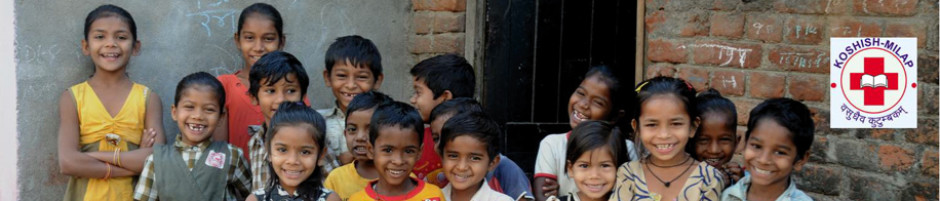
Here are few examples of how our efforts are making significant impact in the lives of the children in Mujmahuda slum.
-
- In year 2018-19, the 8th graders became the first batch of students to graduate from our program. They have been with us from the beginning and we are elated with their success and achievements. We are honored to report that 5 out of 12 students were selected for an academic Scholarship from Mahavir International Foundation. Two of those students joined the 9th grade at prestigious Baroda High School. Similarly in 2019-20, two out of six of our students were accepted for grade 9-12 programs by Sai Angel Foundation, Vadodara.
- Every year, about 20% of the academically weak students in content areas could improve after counseling and extra coaching.
- Some students fear their parents because of parental physical/verbal abuse. One of such students was so scared of her parents that she would cry when she heard their names. However, after counseling the student and parents, the unjust treatment terminated.
- Two 4th grade female students were disruptive in the class. Teacher practically showed them how talking in the class impairs learning by demonstrating progress with and without talking. The students reduced disruption.
- In grade 5 and 6, 14 students’ handwriting was illegible. It became a project to improve their handwriting for a month. The students had to rewrite everything if their writings were not neat. Initially, the students did not like this, but finally most of them started writing better except one.
- Two cousins were attending the 1st> grade at the nearby government school. Initially both of them were showing apparent signs of learning disability and emotional disturbance. They used to chew/suck their shirt, collar, pencil and even their finger and toe. Initially for few days, the teacher had to go to their home and bring in the class. They were unable to hold pencil or chalk properly. After two months of rigorous training for ‘Fine Motor skills’ they could improve in pencil grip. Their behavior also improved after listening to stories.
- In the beginning the students were careless towards the books and other teaching materials. They were motivated to take care of classroom material by introducing an idea of collective belonging of the classroom.
- Five cousins (age 5-10 years) whose parents migrated from Gujarat to slum in Kolkata for employment and then came to Mujmahuda slum in Vadodara. Like their parents, they never attended the school. We used their own names and extended family members’ names as a strategy to teach alphabets and words. This exercise awakened their hunger to learn reading and writing. In fact they used to reach the class before scheduled time and wait for the teacher. Due to their high enthusiasm, we had extended their teaching session from four hours to six hours. They all worked hard. We approached the nearby school principal and admitted them in appropriate grades.
- A second grade student on admission was unable to hold the pen correctly, but with our intense support she was able to pick up 1st grade material in six months. She also learnt quickly Hindi and English alphabets. This smart girl taught her mother how to sign instead of thumb impression. There were four other such students who taught their mothers to write their names.
- A 10 year girl with surgery of split palate has a speech problem. On admission she was looking like mentally challenged, but with our support she grasped material of two grades in one year. In fact now she is in 12th grade.
- We counsel parents not to push for premature admission in 1st grade so that student is mature enough to grasp the grade level teaching material. We were able to convince few parents to retain their children if they were performing at below grade levels. Our experience shows that these students are better in maintaining satisfactory academic performance.
- Grandmother of a five year bright girl was highly interested in educating her granddaughter. We decided to sponsor the child for a private school. The private school principal wanted to see the student before admission. When we went to her home with this good news, we found that the girl had left for railway station with her mother to go to her uncle’s place for a month. The grandmother was worried about losing the admission and rushed to railway station, brought her back and next day, we could enroll the girl into private school.
- Rudra, a kindergarten student, remained isolated from the other students, did not take part in joint activities, did not draw or write anything on the slate. So the teacher approached his family and found out the reason for this isolation. He is the only child in the family. Because the family members were afraid that Rudra would be spoiled if he mingles with others in the slum, he was not allowed to play with his friends. He lacked confidence to such an extent that he did not color or draw a single line. He was not expressive also. To gain his confidence, the teacher worked with him individually, helped him draw a single line scratch and color the picture by holding his hand. Working individually and paying personal attention for a month, he realized his abilities and started gaining confidence. After a month of these individual efforts, Rudra was able to become confident and expressive. Now, like other students, he has become mischievous and talkative.
- Language learning through play is well established fact. Play improve reading and speaking skills, encourage creativity, help them experiment with language including body language, tone of voice, and writing the speech, making them expressive and confident. We also used drama in teaching a language. The stories were converted to stage play. This idea became highly popular and students themselves started converting stories into play and performed. That also helped them to remember the lesson.
- Three senior KG students (one male and two females) faced a problem in expressive language-phonological processing to recognize that spoken language can be broken down into smaller units of words. Therefore, they were unable to identify pictures and numbers rapidly, unable to produce rhythmic words, unable to carry out oral directions, and they had poor attention span. Out of these three students, the male student would replace all Gujarati vocal sounds like /k/, /kh/, /g/ and /gh/ with /t/ sound. For two months, one full time teacher was working with only these three kids paying individual attention and applying variety of interventional techniques to support their learning. They were provided phonological awareness activities like rhyme recognition and rhyme completion. To make them more attentive and to better retain as well as retrieve the concepts and information, they were provided with repetition and multisensory experiences including visual, auditory, tactile and kinesthetic. For example, when teaching numbers and letters, have them trace large letters both in slate and in sand, and elicit the letter name. They were given exercises to classify in order to help improve knowledge and vocabulary. Through drawing and tracing different shapes on slate, paper, and board and making variety of objects out of different shapes made them familiar with shapes, and later on with numbers. Using abacus and beads, blocks, red rods and number rods, songs, games, and hands-on activities they were taught counting, number recognition, days of the week, shapes and other pre-math skills. Various books, workbooks, and games were used to provide opportunities to reinforce skills. These interventions made a significant difference in two female students, but a male student is still struggling.
- Vijay, a 5th grade student, is talented but lacked self-confidence. He never completed his homework or class work on his own. He was clever in finding a way to copy from others. He began finding it challenging to read and understand even simple sentences as he entered the 5thgrade. The teacher found out what he can do better. The teacher then began to build upon his abilities. Slowly, he gained some confidence that he could understand and also sometimes outperformed other students. The teacher worked with him one-on-one. The teacher’s home visits strengthened his intense interest. We had to get him to read a paragraph of five to six phrases after giving him simple comprehension sentences such as, “In the novel, where did Mohan live?” We had to take him to read a paragraph of five to six sentences. Additionally, we placed him in various buddy learning groups; all but one failed. After working for over six months, he finally gained enough confidence to start assisting the teacher in checking other students’ homework without skipping a step, especially in arithmetic. He was able to resolve math problems that nobody of his classmate could do. Vijay, who was forced to sit on the floor all the time and was frequently suspended from his school, has now gained confidence and improved academically. The school teacher was amazed about his academic progress and complimented us.
Appreciations of Teaching Efforts
-
- Few comments from parents:
“Here the method of teaching is excellent. Teachers treat students like their own children.”
“As the education centre is within slum, we do not have to worry about children’s safety because they can walk to the classes by themselves.”
“Children learn better. Here they teach with love and affection.”
“Other private class are charging high fee of Rs 10,000 per year, here the fee is only Rs 600, but the teaching is far better.”
“All students are treated impartially.”
“Now my child is better disciplined, less mischievous and helping more at home.”
-
- Few comments from students:
“We love to come here because teachers do not discriminate and love us equally.”
“We can understand the concepts here and now we can point to our teachers’ mistakes.”
“Here teachers do not beat us.”
“Here we have freedom of expression.”
“Because of nominal fees, our parents save money and we learn better.”
“We want to become teacher, engineer, police, doctor, soldier etc.”
“Many of the students have expressed their preference for studying in our class instead of going to the school. When a possibility of starting an Open School was discussed in a class, almost all students were excitedly asked, “Can we stop going to school from today?”